
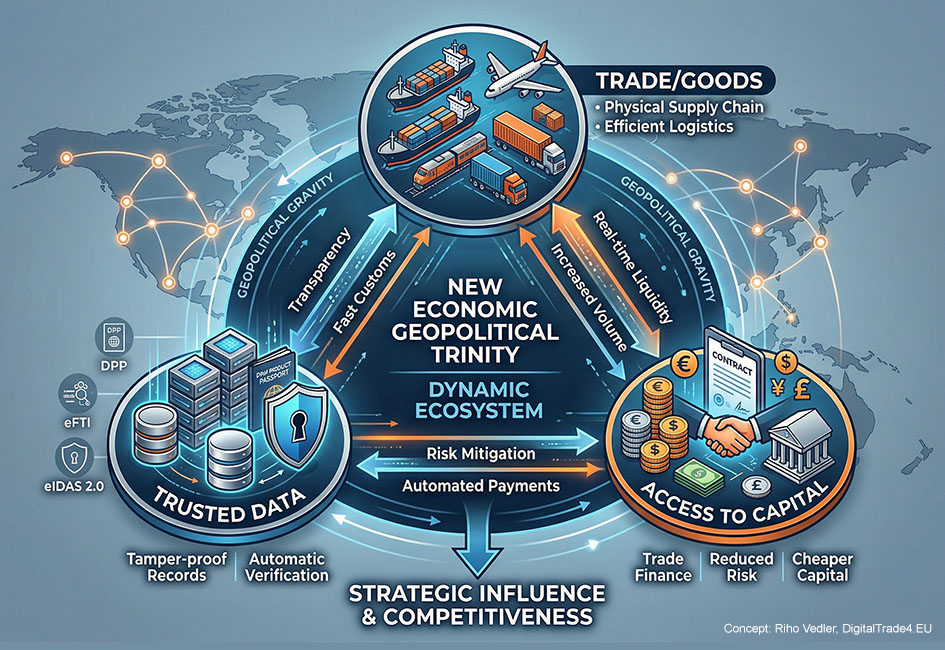
The European Union has quietly built one of the world’s most advanced digital regulatory ecosystems. With instruments such as the Digital Product Passport (DPP), electronic Freight Transport Information (eFTI), and eIDAS 2.0, the EU is shaping how data, trust, and compliance function within its internal market. Yet beyond its borders, this regulatory strength risks remaining underleveraged.
The challenge is not a lack of ambition, but a missing link. EU digital regulations are not systematically embedded in trade policy. As a result, Europe regulates effectively at home, while others—most notably the United States—shape the rules of global digital trade.
The New Trinity of Economic Geopolitics
Modern economic power is increasingly defined by the interaction of three elements:
- the movement of goods,
- trusted digital data,
- and access to capital.
These are no longer separate domains. Goods cannot move efficiently without data, data has no value without trust, and neither delivers its full impact without financing. This is where the EU’s current gap becomes strategic.
Trusted data is not an end in itself. Its real value lies in enabling liquidity, reducing risk, and accelerating financial flows across supply chains.
Why the Brussels Effect Falls Short in the Digital Economy
The EU has long relied on the “Brussels Effect”, assuming that strong regulation will naturally diffuse globally. In traditional sectors, this has largely held true. In the digital economy, however, the dynamic is different.
Digital systems are not just rules that others can adopt—they are infrastructures that must function across borders in real time. A Digital Product Passport is not simply a compliance obligation; it is a data architecture. eFTI is not merely a digital document; it is a logistics information layer that must be interoperable across jurisdictions. eIDAS 2.0, in turn, creates cryptographic trust that only generates value if recognised internationally.
Without formal integration into trade frameworks, these systems remain siloed. Data cannot move seamlessly, verification becomes fragmented, and the economic value embedded in these frameworks is only partially realised. In this context, regulation alone becomes latent power.
From Trusted Data to Cheaper Capital
The true leverage of digital systems emerges most clearly in finance. When banks and trade finance providers can rely on verified, real-time data—such as logistics information transmitted via eFTI or contracts authenticated under eIDAS—the risk profile of transactions changes fundamentally.
This shift produces three immediate effects:
- transaction risk decreases due to verifiable and tamper-proof data,
- due diligence becomes faster and more automated,
- and the cost of capital declines for businesses.
In practical terms, this transforms trade finance from a document-driven process into a data-driven one. Financial flows can be triggered automatically when verified events occur—for example, when goods are loaded or cleared at a border. What once took days or weeks can happen in seconds.
This shift also has direct implications for how financial institutions assess and price risk. When transactions are supported by continuous, verifiable data flows rather than static documents, exposures become more transparent and predictable. This enables a reduction in risk-weighted assets, improves capital efficiency, and allows financial institutions to scale trade finance operations with lower operational overhead.
At the same time, liquidity can be mobilised more dynamically across value chains. Instead of being locked behind sequential verification processes, capital can be released in response to verified events, creating a form of real-time, event-driven financing. The result is not only faster transactions, but a structural acceleration of liquidity across the entire trading ecosystem.
Geopolitical Gravity Through Digital Ecosystems
Over time, these dynamics create a powerful structural advantage. Jurisdictions that successfully align logistics, trade, and finance within a shared digital ecosystem become more attractive for global business. Transactions are faster, risks are lower, and capital flows more efficiently.
This creates a form of geopolitical gravity. Companies begin to route trade through such systems, and financial flows naturally follow. Standards embedded in these ecosystems become dominant not by decree, but by usage.
This is precisely why the current EU gap matters.
While Europe Regulates, Others Set the Rules
Without linking its digital regulatory frameworks to trade policy, the EU risks limiting their global reach. Meanwhile, other actors are moving decisively. The United States, for example, is embedding digital rules directly into bilateral agreements and linking them to market access. These agreements consistently include commitments on data flows, digital taxation, and non-discrimination , reflecting a clear understanding that digital rules shape trade outcomes—and ultimately influence capital flows.
Addressing Concerns from Partner Countries
A more assertive EU strategy will inevitably raise concerns, particularly among developing economies. Conditionality may be perceived as increasing compliance costs or introducing new barriers to entry.
These concerns are legitimate, but they must be assessed against the alternative. Fragmented systems create duplication, legal uncertainty, and higher long-term costs—especially in access to finance.
The difference lies in design. If the EU combines its standards with:
- technical assistance,
- capacity-building,
- and infrastructure investment (e.g. Global Gateway),
then alignment becomes an opportunity rather than a burden. It enables integration into more efficient, lower-risk trade and financial ecosystems.
Infrastructure vs. Standards: Building a Universal Trust Layer
Imagine a world where global trade required every country to speak the same language. Such a demand would face immediate resistance and would be practically impossible to implement. Yet in digital trade, this is often the implicit approach: attempting to impose uniform data standards and local formats across diverse systems. True global scalability, however, will not come from standardization alone, but from the creation of a shared and trusted infrastructure.
The European Union does not need to export its specific data formats, but rather an architecture of trust. This means establishing a framework that allows different systems, countries, and businesses to interact without first having to harmonize their entire data structures or processes. Such an approach respects diversity while creating a common foundation for trust.
At the core of this model is not the question of how data is formatted, but whether it can be trusted. If parties can independently verify that information is authentic, that its origin is clear, and that it has not been altered, then the format of the data becomes secondary.
This shift transforms the nature of trade. Instead of adapting each transaction to multiple standards, the focus moves toward ensuring that all transactions are reliably verifiable. This creates the conditions for seamless interaction across highly diverse systems and markets.
The question is no longer about standards, but about the functioning of trust.
This shift is strategic. It does not only reduce technical barriers, but also reshapes the logic of global trade. Those who provide a functioning trust framework will directly influence how goods, services, and capital flow.
By focusing on infrastructure rather than standards, Europe can create an environment where even small and medium-sized enterprises can participate in global trade on equal footing. Trust becomes not a privilege, but a shared capability—enabling a more scalable, inclusive, and truly global digital economy.
From Regulation to Trade Power
The strategic task for the European Union is not to invent new instruments, but to activate and connect the ones it already has. At their core, frameworks such as DPP, eFTI, and eIDAS 2.0 should not be seen merely as regulatory requirements, but as building blocks of a shared digital trade infrastructure.
To unlock their full value, these systems must be embedded into trade policy—through, for example, dedicated digital trade chapters in FTAs, targeted mutual recognition agreements (MRAs), and interoperability provisions that allow systems to function seamlessly across jurisdictions.
This shift is critical. On their own, regulatory frameworks remain bounded by jurisdiction. When connected through trade agreements, they become part of an operational system that enables trusted data exchange across borders.
In doing so, the EU would not simply export regulation—it would scale a functioning digital trade infrastructure. And in a system where infrastructure determines how data flows, how trade is executed, and how risk is priced, this also means shaping the conditions under which capital moves.
Conclusion
Digital trade is no longer just about moving goods or exchanging data. It is about reducing risk, unlocking capital, and shaping the systems through which global commerce operates.
The European Union has already built the foundations. The remaining question is whether it will connect them to its trade policy in time to shape the emerging global order.
Riho Vedler, DigitalTrade4.EU