
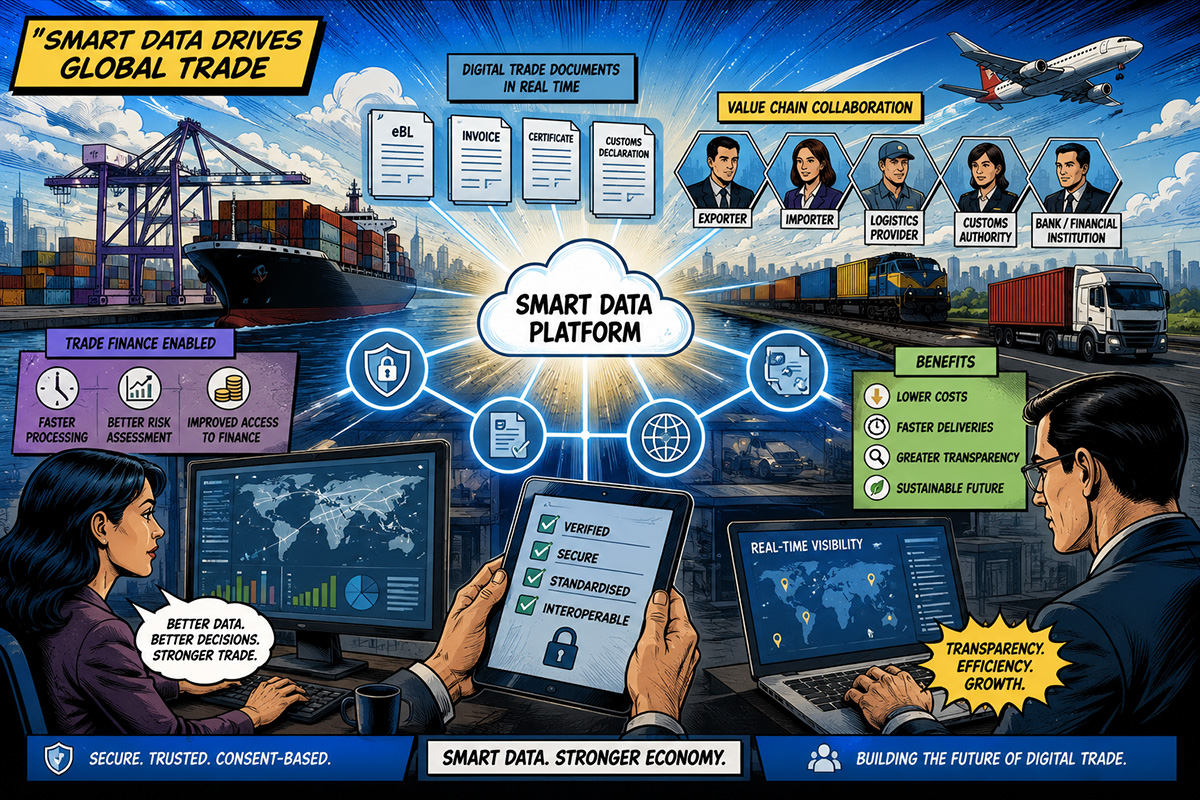
The UK Department for Business and Trade commissioned report “Economic analysis: understanding the costs and benefits of smart data use cases” examines how Smart Data schemes could reshape the economy, supply chains, and financial ecosystems over the next 15 years. The report focuses particularly on the role of Smart Data in international trade, trade finance, and value chains.
According to the study, the five Smart Data use cases analysed could generate a total of £26.3 billion in net social value for the United Kingdom between 2028 and 2043, while contributing an additional £3.6 billion annually to GDP by 2043. The digitisation of international trade and trade finance represents a major component of this impact, with an estimated £3.6 billion in net value and a projected annual GDP contribution of £0.93 billion.
Smart Data as a New Trade Infrastructure
The report defines Smart Data as the secure and standardised sharing of data between businesses, consumers, and authorised third parties. Its objective extends far beyond simple digitalisation of processes; it aims to restructure entire economic value chains.
In the trade context, this means transforming fragmented and paper-based procedures — such as bills of lading, customs documentation, manifests, and payment records — into a real-time digital ecosystem. The report highlights that international trade still depends heavily on slow paper-based workflows that generate delays, additional costs, and liquidity constraints. Smart Data schemes would enable electronic trade documents and financial records to be securely exchanged through Authorised Third Parties (ATPs).
Such a model would create an entirely new data-driven value chain in which exporters, importers, logistics companies, banks, insurers, and customs authorities operate through a shared standardised data layer.
Trade Finance Digitisation as a Driver of Economic Growth
One of the report’s key conclusions is that the digitisation of trade finance could become a direct driver of economic growth. The largest benefits stem from three main factors:
- faster document processing;
- more efficient due diligence;
- improved access to working capital.
Digital data sharing would significantly reduce the time required for document verification and customs processing. Importers and logistics companies would benefit from improved productivity as goods move more rapidly through supply chains. Financial institutions would be able to conduct faster risk assessments and issue trade finance instruments with lower administrative burdens.
The report also identifies liquidity improvements as a major source of value creation. When trade documentation flows automatically through digital systems, companies gain faster access to financing and reduce the amount of capital tied up in pending transactions. This strengthens the financial resilience of entire supply chains.
Reshaping Value Chains
The study applies a methodology called Value Chain-based Simulation Modelling (VCSM), designed to analyse how value flows between different market actors.
Within the trade finance value chain, Smart Data implementation would create several structural changes:
- exporters would transition from paper documentation to digital platforms;
- importers would gain faster access to verified data;
- logistics providers would automate documentation and customs data flows;
- banks would utilise real-time verified information for credit risk assessment;
- customs authorities would automate verification and compliance procedures.
The report argues that the impact goes far beyond process acceleration. Smart Data creates entirely new opportunities for transparency and traceability across value chains. Although the study does not fully quantify the impact of ESG, carbon footprint tracking, and ethical supply chain verification, it highlights that standardised trade and manifest data could eventually support carbon accounting, human rights compliance monitoring, and automated tariff reporting.
This is particularly relevant for the future development of digital trade and ESG-linked trade finance.
International Cooperation as a Critical Requirement
The report emphasises that Smart Data schemes in international trade cannot reach their full potential without international legal cooperation. Full benefits require digital trade agreements or mutual legal recognition of electronic trade documentation frameworks.
Under the report’s current assumptions, the UK would initially be able to digitise only import-related processes. As a result, exporters would experience more limited gains and may even face temporary negative impacts due to the upfront costs of digitalisation and platform membership fees before full international interoperability is achieved.
This demonstrates that Smart Data is not merely a technological issue, but also closely linked to trade law, regulation, and international standards.
ATPs as the New Digital Trade Intermediaries
The report describes Authorised Third Parties (ATPs) as a new category of market actor. ATPs function as trusted intermediaries responsible for collecting, validating, and distributing standardised data across the ecosystem.
In the trade finance context, ATPs could:
- manage electronic trade documents;
- provide identity and data verification services;
- coordinate information flows between banks, customs authorities, and logistics providers;
- develop new data-driven services for risk assessment and ESG compliance.
This positions ATPs as a potentially strategic layer within the future global digital trade architecture.
Implications for the Future of Trade
The report’s central conclusion is that Smart Data schemes could become as transformational for trade as Open Banking has been for financial services. In international trade, this would translate into:
- lower administrative burdens;
- faster cross-border transactions;
- improved liquidity;
- enhanced risk management;
- greater supply chain transparency;
- new opportunities for ESG and digital compliance integration.
Although the report acknowledges that implementation will require substantial investment and international coordination, the economic modelling clearly demonstrates that Smart Data-enabled trade finance could become one of the most important pillars of next-generation digital trade infrastructure.
Summarry by DigitalTrade4.EU