
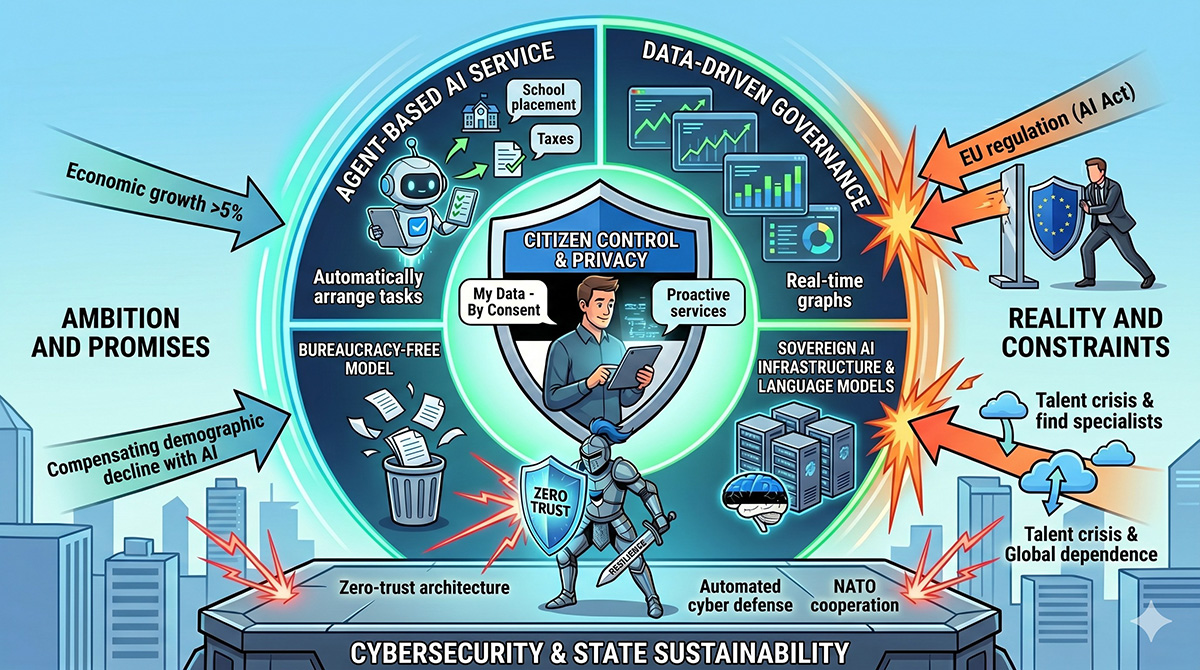
Estonia’s new strategy document, Estonia’s Digital Agenda 2035, represents far more than a conventional public-sector IT development plan. In reality, it outlines a vision for an entirely new model of governance in which artificial intelligence, data-driven administration, and automated public services become the central operating mechanisms of the state. Reading the document creates the impression that Estonia no longer wants to be merely a successful “e-government” country, but rather the world’s first fully AI-adapted democratic digital state.
This ambition is remarkable not only in Europe but globally. Most countries still speak about digitalisation, whereas Estonia is already discussing the next generation of statehood: agentic AI, sovereign computing capacity, data-driven governance, and a zero-bureaucracy model. At the same time, Estonia seeks to preserve core European rule-of-law values: transparency, individual control over personal data, and the right to challenge AI-driven decisions.
Yet the success of this vision will depend not only on algorithms and regulation, but also on the human and physical infrastructure required to keep a digital state functioning in real life.
The Digital State as a New Governance Model
The central idea of Estonia’s digital agenda is to make the state as invisible as possible. Public services should reach citizens before they even request them. The public sector should function automatically, using personal data with citizens’ consent in order to reduce bureaucracy and accelerate decision-making.
This approach differs fundamentally from the traditional e-government model. Earlier generations of digital government focused mainly on providing online access to services. Estonia’s new model envisions the state becoming an active digital assistant. The strategy describes scenarios in which informing the government about a family relocation automatically triggers an entire service chain — school placements, tax calculations, and local public services are all arranged proactively.
Such a system could make public administration more efficient than ever before. However, it also creates unprecedented dependence on data quality, interoperability, and cybersecurity. The more decisions the state automates, the greater the consequences of systemic errors or misuse.
Estonia’s Boldest Objective: Becoming an AI State
The most ambitious part of the document is undoubtedly the goal of transforming Estonia into “the world’s freest and most human-controlled AI-driven state.”
Estonia does not intend to use AI only in isolated services. The strategy envisions:
- widespread deployment of AI agents in the public sector;
- mandatory AI adoption in certain processes;
- the creation of a national AI applications catalogue;
- sovereign national AI computing infrastructure;
- development of local language models.
Most notably, Estonia directly links AI development to national competitiveness. The strategy sees AI as a tool for compensating for demographic decline and generating annual economic growth exceeding 5%.
The economic dimension of the strategy is substantial. Estonia estimates that approximately EUR 1.8 billion will need to be invested between 2026 and 2035 in order to implement the agenda. At the same time, the government argues that systematic adoption of AI could reduce public-sector service, development, and process costs by at least EUR 425 million. In other words, the strategy frames digital transformation not merely as a technological investment, but as a long-term restructuring of the state’s operating model.
In my assessment, however, the projected economic impact is only partially realistic. AI can certainly increase productivity and reduce administrative costs, but sustained annual growth above 5% would be extremely ambitious for an advanced European economy, especially in a period marked by demographic ageing, geopolitical instability, and structural economic challenges across Europe.
At the same time, Estonia’s small size is a strategic advantage. Systemic reforms can be implemented far more rapidly in a small state than in large federal systems. While countries such as Germany or France must coordinate across multiple regional layers, Estonia can deploy centralised solutions comparatively quickly.
Individual Control Versus the Automated State
One of the most interesting aspects of Estonia’s digital agenda is its attempt to reconcile automation with individual freedoms. The document repeatedly emphasises that citizens must retain control over their personal data and that AI decisions must remain transparent and contestable.
This is a crucial distinction from more authoritarian digital governance models, where technology primarily expands state control. Estonia is attempting to build a European alternative: a highly automated state that remains subordinate to democratic principles and the rule of law.
In practice, however, this balance will be difficult to maintain. As AI begins making more administrative decisions, fundamental questions emerge:
- How well can ordinary citizens truly understand algorithmic decision-making?
- Can individuals realistically defend their rights against complex AI systems?
- Does the state possess enough expertise to effectively supervise these systems?
The more sophisticated AI models become, the harder full transparency may be to preserve.
Importantly, Estonia’s strategy does not leave these concerns entirely abstract. The document proposes several concrete mechanisms intended to preserve citizen oversight and legal accountability:
- all AI use cases in the public sector are to be explicitly labelled;
- citizens will be able to use a “data tracker” to verify how their personal data is being used;
- citizens will be able to check whether the use of their data is authorised;
- automated administrative decisions can be appealed;
- individuals may request access to the corresponding decision-making trail or record explaining how the AI-supported conclusion was reached.
Perhaps most importantly, the strategy guarantees that automated administrative decisions can be appealed, and individuals may request access to the corresponding decision-making trail or record explaining how the AI-supported conclusion was reached. This is a highly significant legal principle. Many countries discuss trustworthy AI in abstract terms, whereas Estonia is attempting to operationalise algorithmic accountability within public administration itself.
Estonia’s AI Agenda Versus European Union Regulation
The greatest strategic challenge for Estonia’s digital agenda may not be technology or funding, but rather the European Union’s regulatory framework. Estonia wants to become one of the world’s fastest-moving AI-driven societies, yet it operates within an EU legal environment that approaches artificial intelligence primarily through the lens of risk management and fundamental rights protection.
This creates an inherent tension between innovation and regulation.
According to the digital agenda, Estonia aims to:
- deploy agentic AI in public administration;
- automate administrative processes;
- create proactive AI-driven government services;
- build sovereign AI computing infrastructure;
- implement real-time data-driven governance.
However, the European Union’s regulatory approach is considerably more cautious. Europe’s objective is not necessarily to become the world’s fastest AI adopter, but rather the safest and most regulated AI market.
The key regulatory framework here is the European Union Artificial Intelligence Act, which establishes extensive requirements concerning:
- high-risk AI systems;
- data quality;
- transparency;
- human oversight;
- documentation;
- accountability structures.
Public-sector AI systems often fall into the “high-risk AI” category. As a result, every new system may require:
- impact assessments;
- certification procedures;
- conformity assessments;
- regulatory supervision.
This could significantly slow down the pace of innovation envisioned in Estonia’s strategy.
Here, Estonia faces a classic small-state paradox. Its greatest strength has always been speed — the ability to make decisions rapidly, experiment flexibly, and consolidate systems efficiently. Yet as an EU member state, Estonia cannot develop a fully autonomous AI policy. Even if Estonia wishes to move faster, it must comply with:
- the AI Act;
- GDPR;
- the NIS2 Directive;
- EU data governance regulations;
- cybersecurity certification frameworks;
- the European Digital Identity framework.
In practice, this means technological development may become dependent on the pace of regulatory evolution in Brussels.
In my view, there is a very real risk that parts of Estonia’s AI ambition could become trapped in legislative bureaucracy. The European regulatory model is built around the precautionary principle, whereas Estonia’s digital agenda emphasises experimentation and innovation. The strategy explicitly states that the public sector must “dare to experiment intelligently” and that calculated risk-taking should not be punished.
This may create a situation in which:
- innovation advances faster than regulation;
- public institutions become legally risk-averse;
- AI deployment slows considerably;
- substantial resources are redirected toward compliance documentation and audits.
This challenge may become especially acute in the case of agentic AI, since European regulatory structures are not yet fully adapted to autonomous AI-agent ecosystems.
At the same time, Estonia does not intend to remain merely a passive rule-taker inside the EU framework. The strategy explicitly states that Estonia’s strategic digital interests must be actively defended at both the EU and international levels. Estonia also plans to participate actively in international data exchange initiatives, interoperability projects, and the creation of cross-border digital services.
This is strategically important. Estonia appears to understand that if it cannot fully escape European regulation, it must instead attempt to shape the future direction of European digital governance from within.
The European framework is therefore not merely an obstacle. It may also become Estonia’s strategic advantage. Estonia consistently emphasises trust, transparency, and citizen control over data. These principles align closely with the EU’s broader regulatory philosophy.
If the American model is driven primarily by market dominance and the Chinese model by state control, Estonia could emerge as a distinctly European third model:
- rapid innovation,
- but within a strong rule-of-law framework.
If Estonia succeeds in demonstrating that an AI-driven state can simultaneously be:
- efficient,
- secure,
- transparent,
- and respectful of fundamental rights,
then Estonia may begin influencing the future evolution of European AI governance itself.
AI Infrastructure as a Cultural and Strategic Question
One of the more overlooked aspects of Estonia’s digital strategy is that the development of local AI infrastructure is not framed merely as a technological or economic issue, but as a cultural and existential one.
The strategy explicitly states that large language model development must be continuously supported in order to ensure the survival of the Estonian language and culture in the AI era. By 2027, language data itself is to be formally recognised as a valuable national dataset.
This is highly significant for a small-language nation. In the AI era, languages that are poorly represented in global AI systems risk gradual digital marginalisation. If future AI ecosystems function primarily in English and other major languages, smaller linguistic communities could lose visibility, accessibility, and eventually cultural relevance within digital environments.
Estonia’s response is therefore strategic as much as technological. Building sovereign AI capacity and supporting Estonian-language models becomes not only an innovation policy, but also a form of cultural preservation and digital sovereignty.
Cybersecurity as an Existential Question
Estonia approaches cybersecurity not as a technical IT issue, but as a matter of national survival.
This logic is straightforward. The more the state digitises:
- healthcare;
- finance;
- identity systems;
- communications networks;
- energy infrastructure,
the more vulnerable society becomes to cyberattacks.
For this reason, the strategy prioritises:
- zero-trust architecture;
- automated cyber defence;
- centralised protective mechanisms;
- cooperation with NATO and Ukraine;
- full operational continuity of critical infrastructure during crises.
In my assessment, this is the strongest and most realistic part of the strategy. Estonia is already among the world’s cybersecurity leaders, and current geopolitical realities make continued investment in cyber resilience unavoidable regardless of economic conditions.
Cybersecurity can no longer be separated from the resilience of physical infrastructure. A digital state depends not only on secure software, but also on electricity supply, telecommunications networks, data centres, backup systems, and trained technical personnel capable of maintaining services under pressure. In this sense, Estonia’s cyber resilience also depends on the resilience of its physical digital infrastructure.
The Human and Physical Infrastructure Behind Estonia’s Digital State
One layer of Estonia’s Digital Agenda 2035 deserves stronger attention: the human and physical infrastructure behind the digital state. Digital government is often described through AI systems, data exchange, cybersecurity, cloud architecture, and automated services. Yet none of these systems can function without the people, networks, energy systems, data centres, and technical maintenance capacity that keep the digital state operational in real life.
1. Human Capital as a Strategic Bottleneck
The first challenge is human capital. Estonia’s AI-driven state will require:
- AI specialists;
- cybersecurity experts;
- data governance professionals;
- system architects;
- service designers;
- digital procurement experts;
- public-sector technology leaders.
These are precisely the same people being recruited by global technology companies, defence technology firms, cloud providers, financial institutions, and cybersecurity firms. For a small country, this creates a strategic vulnerability. Estonia cannot build an advanced AI state if its most capable digital specialists are continuously pulled into better-paid global private-sector roles.
2. Public-Sector Competence and Digital Sovereignty
This challenge is particularly acute in the public sector. The state does not need to develop every technological solution internally, but it must retain enough expertise to be an intelligent owner, buyer, regulator, and supervisor of digital systems. If the public sector loses strategic technical competence, it may become dependent on external vendors for architecture, cybersecurity assessments, AI deployment, data governance, and long-term system design. That would create a new form of digital sovereignty risk.
The risk of brain drain must therefore be treated as a core digital sovereignty issue. Estonia increasingly competes for the same talent pool as the entire European and American technology sector. Rising living costs, salary gaps compared to larger European economies and the United States, and the growing possibility of remote work for international employers all create pressure on talent retention. Estonia must therefore offer more than employment. It must offer meaningful missions, attractive career paths, flexible working conditions, strong research cooperation, and a public-sector culture where top technical professionals can influence real systems at national scale.
3. The Technical Workforce Behind the Digital State
The second challenge is the technical workforce that supports the physical foundations of the digital state. Estonia’s digital services depend not only on software engineers, but also on:
- electricians;
- network engineers;
- telecommunications technicians;
- fibre-optic specialists;
- radio network planners;
- data centre operators;
- field maintenance teams.
These professions rarely appear at the centre of digital policy debates, but they are essential for keeping internet connectivity, 4G and 5G networks, future 6G readiness, fibre connections, data centres, backup systems, and emergency communications operational.
4. Physical Infrastructure as a Condition for Digital Resilience
This physical layer is especially important in a security environment where digital and physical vulnerabilities increasingly overlap. Cyberattacks, power disruptions, infrastructure sabotage, supply-chain failures, and geopolitical pressure can all affect the continuity of digital public services. A digital state cannot be resilient only in cyberspace. It must also be resilient in cables, towers, servers, power systems, and maintenance capacity.
This means that Estonia’s digital agenda should also be read as an infrastructure agenda. High-quality mobile coverage, reliable broadband, resilient backbone networks, secure data centres, energy continuity, and technical maintenance capacity are not secondary details. They determine whether AI-driven public services can function outside ideal conditions, including in rural areas, border regions, crisis situations, and periods of heightened security risk. The future digital state must therefore be measured not only by the sophistication of its AI services, but also by the reliability of the networks and technical systems that carry them.
5. Legal and Regulatory Competence in the AI Era
The third challenge is legal and regulatory competence. Estonia’s digital agenda will operate within an increasingly complex European legal environment, including:
- the AI Act;
- GDPR;
- the NIS2 Directive;
- the European Digital Identity framework;
- data governance rules;
- cybersecurity certification systems;
- public procurement law.
Implementing these frameworks requires more than ordinary legal interpretation. It requires lawyers and policymakers who understand how digital systems actually work.
Technology and law often speak different languages. Engineers think in terms of:
- systems;
- interfaces;
- datasets;
- models;
- APIs;
- security layers;
- operational dependencies.
Lawyers think in terms of:
- rights;
- obligations;
- liability;
- procedures;
- evidence;
- definitions;
- remedies.
Estonia’s future digital state will need professionals who can translate between these worlds. Without this capacity, regulation may either slow down innovation unnecessarily or fail to provide meaningful safeguards.
6. Estonia as a Shaper of European Digital Regulation
This also affects Estonia’s role in the European Union. Estonia should not be only an implementer of EU digital regulation. It should also be a shaper of it. Because Estonia has practical experience with digital identity, interoperability, secure data exchange, and online public services, it can contribute to European debates with operational knowledge that many larger states lack. In an increasingly regulated digital economy, legal and regulatory competence itself becomes part of national strategic capacity.
7. Talent Policy at the Speed of Technology
Finally, Estonia’s talent policy must move at the speed of the technology sector. A country of Estonia’s size cannot rely only on domestic talent pipelines. It must continue investing in:
- local education;
- ICT specialisation;
- vocational training;
- applied research;
- interdisciplinary digital governance studies.
But it also needs fast, predictable, and digitally efficient pathways for international specialists. This includes:
- work permits;
- residence permits;
- specialist visas;
- research mobility;
- family integration.
These are not separate from digital strategy. They are part of its delivery mechanism.
Rigid migration quotas, lengthy administrative procedures, or inflexible labour mobility frameworks could gradually reduce Estonia’s attractiveness as a destination for global digital talent. Highly skilled professionals typically compare countries not only by salary, but also by administrative simplicity, family conditions, research ecosystems, professional opportunities, quality of life, and long-term security. Estonia’s competitive advantage should be that its talent system is as digital, fast, and predictable as the public services it promotes internationally.
8. Technology Alone Will Not Deliver the Digital State
Ultimately, Estonia’s Digital Agenda 2035 will not be delivered by technology alone. AI can automate tasks, but it cannot replace strategic judgement, technical maintenance, cyber defence, legal interpretation, infrastructure resilience, or democratic accountability. The more advanced the digital state becomes, the more important its human and physical foundations become.
Can Estonia Realistically Deliver This Vision?
The biggest challenge facing Estonia’s Digital Agenda 2035 is not technology alone, but the combination of capability, continuity, and sovereignty.
The strategy assumes:
- exceptionally strong public-sector competence;
- long-term political continuity;
- sustained funding;
- deep cooperation between the state, academia, and the private sector;
- the ability to adapt both technologically and institutionally.
For a country of Estonia’s size, these assumptions are highly ambitious. The preceding human and physical infrastructure challenge is therefore not a secondary implementation issue, but one of the central conditions for whether the strategy can succeed.
Another structural issue is dependence on global technology platforms. Although the strategy speaks about “sovereign computing capacity,” the reality is that much of Europe’s AI infrastructure still depends heavily on:
- American cloud providers;
- GPU supply chains;
- large international language models;
- global AI ecosystems.
This creates a broader strategic question about digital sovereignty. Estonia may succeed in building one of the world’s most advanced digital governance systems while still remaining structurally dependent on technologies, infrastructure, and platforms controlled largely outside Europe.
In this sense, the ultimate challenge behind Digital Agenda 2035 is not simply digitalisation itself. It is whether a small European state can maintain technological competitiveness, regulatory influence, talent capacity, infrastructure resilience, and strategic autonomy simultaneously in an increasingly centralised global digital economy.
Europe’s Most Important Digital Governance Experiment
Ultimately, Estonia’s Digital Agenda 2035 may become one of Europe’s most important digital governance experiments.
If Estonia succeeds in:
- combining AI with the rule of law;
- preserving citizen control over personal data;
- automating large parts of public administration;
- maintaining high levels of cybersecurity;
- building the human and physical infrastructure required for digital sovereignty,
then Estonia could become a global model for how democratic digital states function in the AI era.
However, if the system becomes too complex, overly dependent on external technology providers, short of critical talent, physically fragile, or loses public trust, the very strengths of the model could become vulnerabilities.
Estonia’s ambition is extraordinary. Some of its objectives are undoubtedly optimistic, but strategic boldness has always been the foundation of Estonia’s digital success over the past 25 years. Estonia views technology not merely as an economic sector, but as the structural foundation of statehood itself. That is what distinguishes Estonia’s digital agenda from almost every other digital strategy currently emerging in Europe.
RIho Vedler, DigitalTrade4.EU