
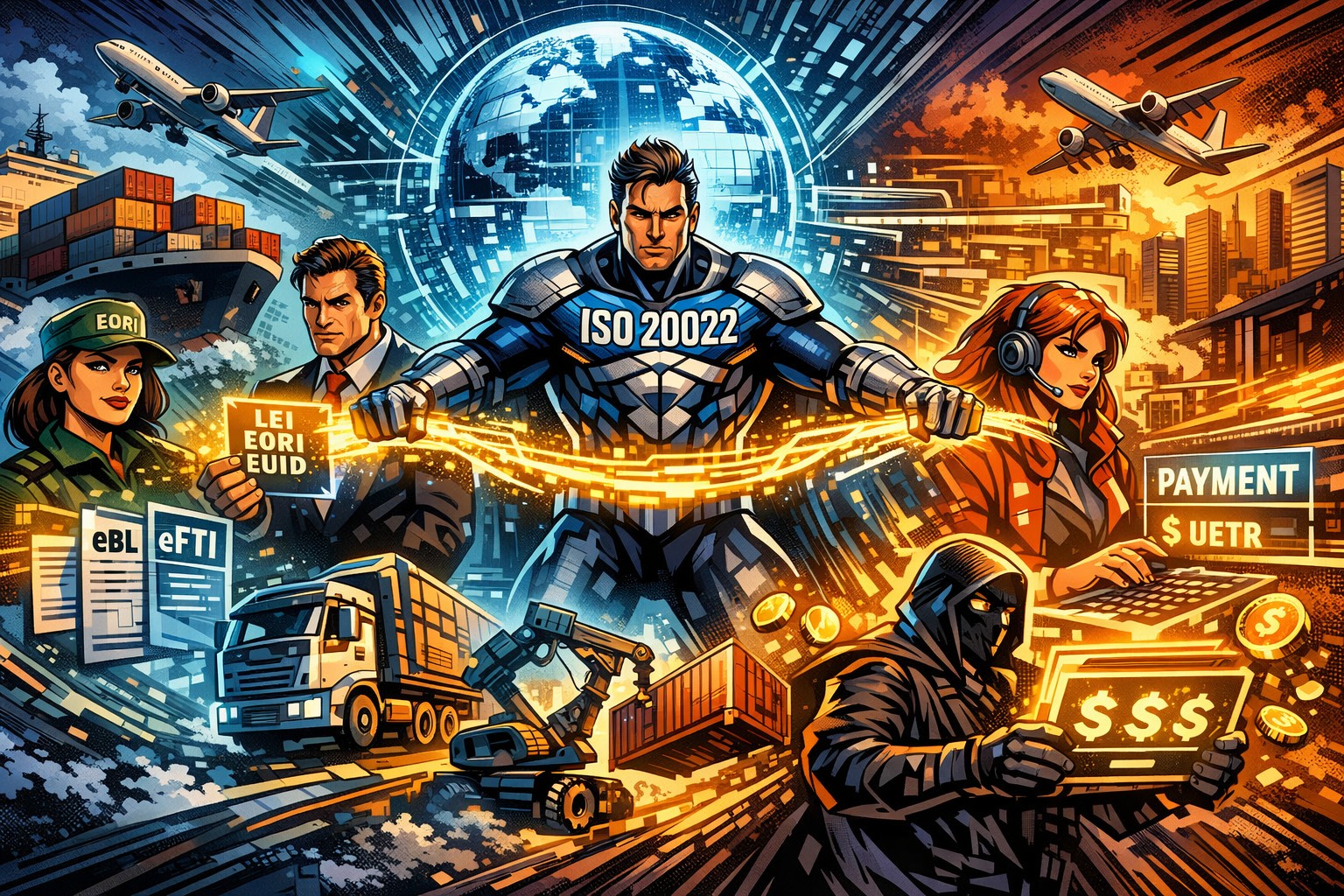
The digital transformation of international trade is accelerating, yet a fundamental bottleneck persists: the fragmentation of payment systems. The study “Fostering ISO 20022 Harmonisation: Cross-border payments interoperability and extension (PIE) task force – Task Team 3, Follow-up report (February 2026)” highlights that while ISO 20022 has been widely adopted, its implementation remains uneven across jurisdictions and infrastructures.
From a digital trade and logistics perspective, this means that goods, documents, and payments still operate in partially disconnected data environments, limiting the full potential of end-to-end digitalisation.
ISO 20022 is often described as a payment messaging standard, but its real significance lies in its role as a structured data framework. It enables richer, machine-readable information flows that can extend far beyond financial transactions.
Key capabilities include:
- structured and granular payment data (parties, purpose, references)
- end-to-end traceability (e.g. via UETR)
- enhanced straight-through processing
- interoperability across financial infrastructures
In the context of digital trade, these capabilities allow payment data to become fully interoperable with logistics and trade documentation systems.
The Broken Data Chain in Global Trade
Today’s global trade ecosystem is characterised by fragmentation across three core domains:
- logistics data (e.g. transport documents, tracking systems)
- financial data (payments, guarantees, trade finance)
- compliance data (KYC, AML, ESG reporting)
These domains often operate in parallel but are weakly interconnected. As a result:
- payments cannot be reliably linked to specific shipments
- risk assessment is fragmented
- supply chain visibility is limited
- automation remains partial
ISO 20022 harmonisation creates the conditions to bridge these gaps.
Linking Payments with Goods and Documents
A harmonised ISO 20022 environment enables a fundamental shift: payments can be directly linked to logistics events and trade documentation.
This allows:
- payments to reference specific shipments
- transaction identifiers (e.g. UETR) to be aligned with logistics tracking IDs
- structured remittance data to connect with digital trade documents (e.g. eBL, eFTI)
The result is a unified digital flow:
- “shipment → document → payment” becomes a single, traceable data chain
This transformation is essential for achieving real-time, data-driven trade ecosystems.
Identity as the Missing Layer in Digital Trade
While data standardisation is critical, it is insufficient without reliable and interoperable identity frameworks. ISO 20022 supports structured identification of parties but does not mandate a single identifier. In practice, multiple identity systems coexist.
Key identifiers in the digital trade ecosystem:
- LEI (Legal Entity Identifier)
- global financial identifier
- supports transparency and risk management
- increasingly embedded in ISO 20022 as a complementary identifier
- EORI (Economic Operators Registration and Identification)
- EU customs identifier
- essential for goods movement and border processes
- directly linked to logistics and trade flows
- EUID (European Unique Identifier)
- company identifier in EU business registers
- connects legal entity data across jurisdictions
Why Interoperable Identity Matters
In practice, the same company is often represented by different identifiers across systems:
- financial systems → LEI
- customs and logistics → EORI
- legal registries → EUID
Without interoperability between these identifiers:
- the same entity appears fragmented across systems
- automated processing is constrained
- compliance and risk assessments are incomplete
A harmonised data environment therefore requires not only standardised messages, but also linked and interoperable identities.
Towards a Unified Identity Layer
ISO 20022 provides the technical foundation to embed multiple identifiers within payment messages. This creates an opportunity to build a unified identity layer, where:
- LEI is linked to EORI and EUID
- payment messages carry consistent cross-domain identifiers
- logistics, financial, and regulatory systems share the same entity references
Such an approach would enable:
- end-to-end “know-your-business” across the supply chain
- improved AML/CFT and ESG monitoring
- seamless integration between trade and finance
Regional Developments and Implications
The study shows that ISO 20022 harmonisation is progressing unevenly across regions:
- Europe demonstrates strong alignment, supported by structured identity systems such as EORI and EUID
- Asia-Pacific combines rapid innovation with heterogeneity across infrastructures
- Americas feature advanced systems alongside legacy constraints
For global supply chains, this means that interoperability challenges persist, particularly when transactions span multiple regulatory and technical environments.
Key Challenges for Digital Trade Integration
Despite significant progress, several obstacles remain:
- fragmentation of identity frameworks (LEI vs EORI vs EUID)
- limited real-time adoption of LEI in payment processing
- lack of integration between payment and logistics standards
- legacy infrastructures restricting full data standardisation
These challenges highlight that digital trade transformation is not purely technological, but also institutional and regulatory.
Strategic Implications for Policy
ISO 20022 harmonisation should be understood as a core component of digital trade infrastructure, not merely a financial sector upgrade.
Its strategic roles include:
- serving as a data backbone connecting trade, logistics, and finance
- enabling cross-border interoperability across systems and jurisdictions
- supporting automation and real-time decision-making in supply chains
The Way Forward
To unlock the full potential of digital trade, the following priorities emerge:
- linking ISO 20022 data structures with logistics standards (e.g. eFTI, DPP)
- establishing interoperability between LEI, EORI, and EUID
- enabling API-based identity validation across systems
- promoting adoption among SMEs through accessible digital platforms
Conclusion
The study “Fostering ISO 20022 Harmonisation: Cross-border payments interoperability and extension (PIE) task force – Task Team 3, Follow-up report (February 2026)” demonstrates that the global financial system is moving toward harmonised data standards. However, true interoperability requires more than technical alignment.
In the context of digital trade and logistics, the next step is clear: to integrate payments, goods, documents, and identities into a single, interoperable data ecosystem.
Achieving this will transform international trade into a system that is:
- faster
- more transparent
- fully traceable
- and increasingly automated
— laying the foundation for a truly digital global economy.
Summary by DigitalTrade4.EU