
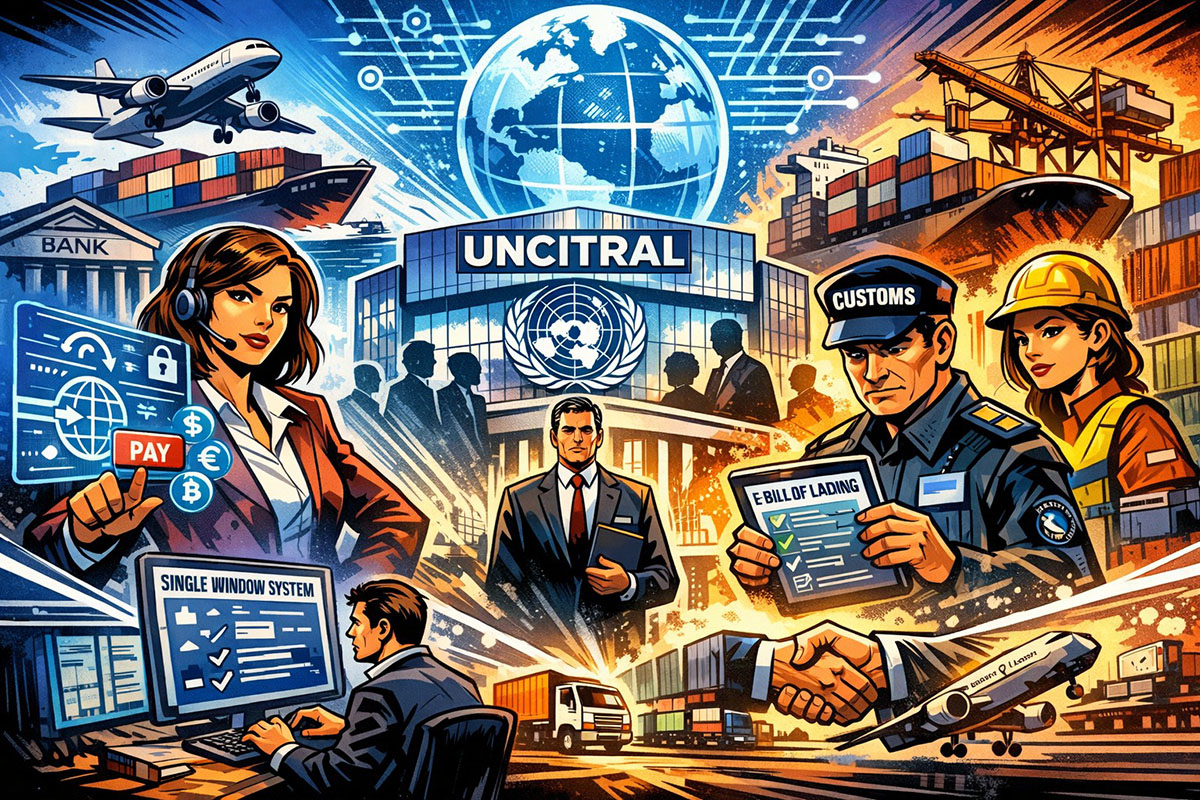
As global trade becomes increasingly digital, legal systems are racing to keep up. Payments are faster, documents are electronic, and supply chains span jurisdictions with very different rules. Against this backdrop, the United Nations Commission on International Trade Law (UNCITRAL) has quietly launched a set of processes that could shape how digital trade works across borders in the years ahead.
At the heart of this effort are two parallel tracks: an exploratory process on digital payments and a preparatory process on paperless trade. While technical in nature, both address practical problems faced daily by businesses, banks, customs authorities, and regulators worldwide.
Mapping the Legal Terrain of Digital Payments
UNCITRAL’s work on digital payments is deliberately exploratory. Rather than rushing toward new rules, the organisation is first asking a more fundamental question: Do existing legal frameworks still work for today’s digital payment systems?
The process begins with a broad mapping exercise. Legal regimes governing digital and electronic payments differ widely across countries, particularly when transactions cross borders. Issues such as when a payment is legally considered “completed,” who bears liability if something goes wrong, and how different payment systems interact are not always clearly answered in law.
UNCITRAL’s approach is to identify these gaps systematically. It also looks at how payment law intersects with financial regulation, including rules on anti-money laundering and counter-terrorism financing. The aim is not to regulate banks or payment providers, but to understand where legal uncertainty may hinder international trade.
Only after this analysis will UNCITRAL decide whether updating existing instruments—or developing something new—would add real value.
Turning Paperless Trade from Policy into Practice
The second process focuses on paperless trade, an idea that has been discussed for decades but remains unevenly implemented. In many countries, trade documents can be electronic in theory, yet paper is still required in practice—especially when dealing with public authorities or cross-border recognition.
Here, UNCITRAL is taking a step-by-step approach. Rather than drafting new laws immediately, it is examining how existing electronic commerce texts can already support paperless trade. Central questions include how electronic documents and data are recognised across borders, and how traders submit information to customs and other authorities, often through so-called “single window” systems.
The preparatory work also draws on experiences from different regions, acknowledging that paperless trade is as much an institutional and procedural challenge as it is a legal one.
Why the Colloquium Matters
Both processes come together at an international colloquium held in Vienna in January 2026. The event brings policymakers, legal experts, international organisations, and private-sector representatives into the same room.
For UNCITRAL, the colloquium serves as a reality check. It allows the organisation to test its findings against real-world experience, identify what works and what does not, and gauge whether there is sufficient consensus to move toward formal guidance or legislative work.
What Comes Next
The outcomes of these processes will be reported back to UNCITRAL’s governing body later in 2026. The result may be modest—further analysis or non-binding guidance—or more ambitious, such as the development of new international legal instruments.
Either way, the direction is clear. By focusing on processes rather than quick fixes, UNCITRAL is positioning itself as a key forum where the legal foundations of digital trade are being quietly but deliberately rebuilt.
Summary by DigitalTrade4.EU