
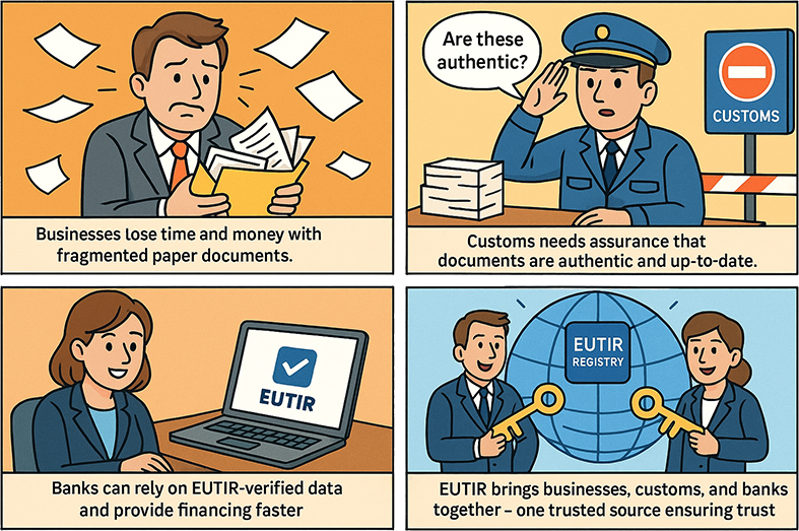
In September 2025, the DigitalTrade4.EU consortium submitted its consolidated feedback to the European Commission: “Towards a Trusted Digital Trade Framework: The Role of the European Trade Indexes Registry (EUTIR).” This document brings together insights from 96 separate submissions and distills them into a strategic vision for Europe’s future digital trade ecosystem.
What is EUTIR?
The European Trade Indexes Registry (EUTIR) is a proposed horizontal trust infrastructure for Europe’s Single Market. Its primary role is to ensure that electronic trade- and compliance-related documents are authentic, traceable, machine-readable, and legally enforceable. Rather than replacing existing registries (such as the Digital Product Passport, eFTI or CBAM), EUTIR acts as an index layer that connects them into a coherent system.
At its core, EUTIR functions as a “trust anchor.” Instead of storing entire documents, it registers metadata such as cryptographic hashes, timestamps, and unique identifiers (EORI, LEI, vLEI). Once the metadata of an electronic document is registered and verified in EUTIR, that document automatically obtains full legal effect across the Union. This principle makes digital trade documents functionally equivalent – and in many respects superior – to their paper counterparts.
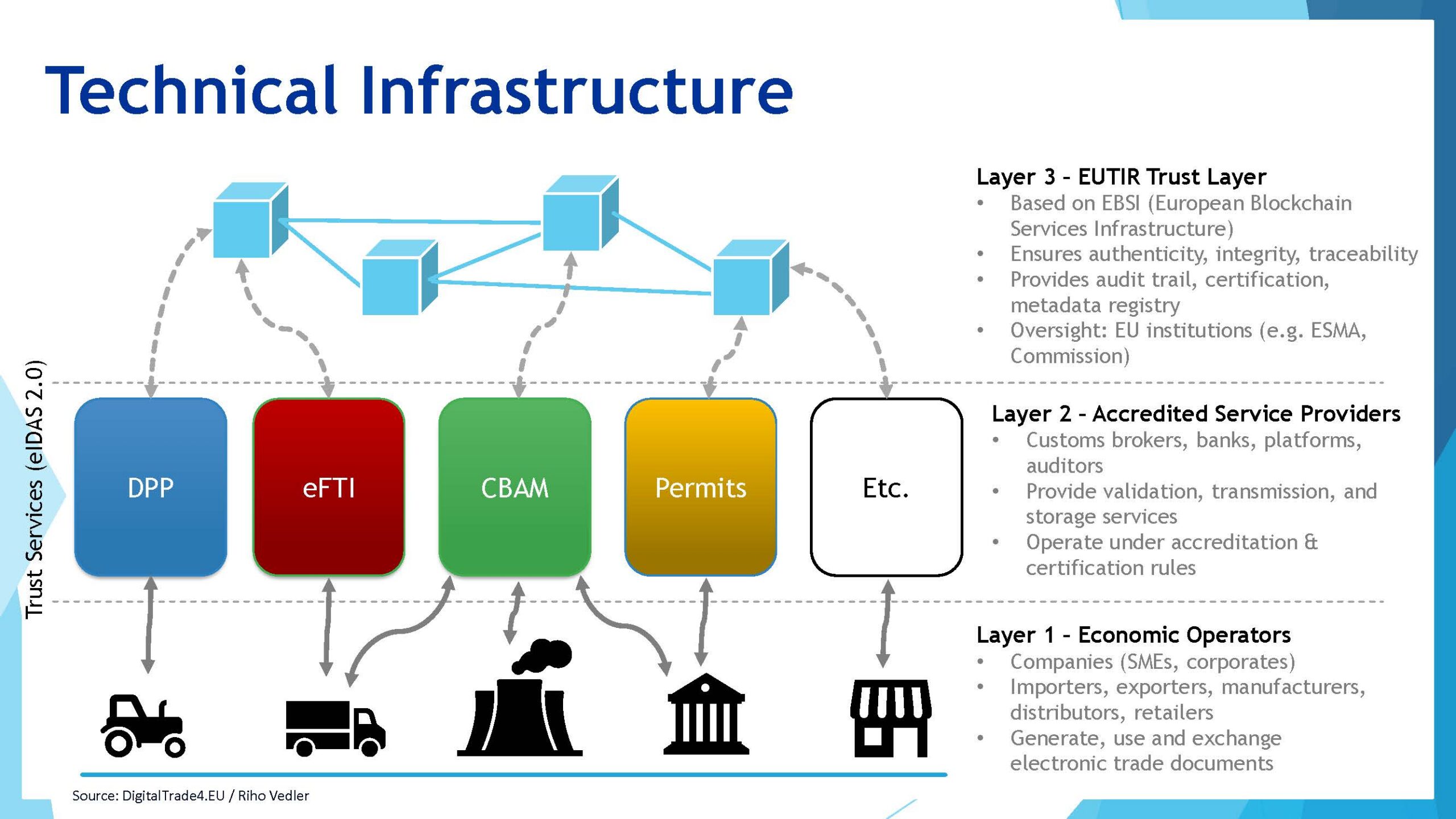
FIgure 2. EUTIR Technical Infrastructure . The three-layer model illustrates how the European Trade Indexes Registry (EUTIR) connects economic operators (Layer 1), accredited service providers (Layer 2), and the EUTIR trust layer based on the European Blockchain Services Infrastructure (Layer 3). By linking Digital Product Passports (DPP), eFTI, CBAM, permits and other compliance datasets into a single trusted environment, EUTIR ensures authenticity, traceability, interoperability, and full legal effect of electronic trade documents across the Single Market.
Why does it matter?
The European Commission’s evaluation of the New Legislative Framework (NLF) in 2022 identified key weaknesses: fragmented digital integration, high compliance costs (especially for SMEs), and limited traceability in sustainability reporting. EUTIR directly addresses these gaps by:
- Reducing administrative burdens through automation and machine-readable verification;
- Strengthening market surveillance by allowing authorities real-time access to verification services;
- Enabling interoperability with global trade and financial infrastructures via LEI/vLEI;
- Supporting the green transition by embedding Digital Product Passports, CBAM reporting, and ESG data directly into one trusted lifecycle;
- Increasing SME participation in cross-border trade through simplified compliance.

FIgure 3. llustrative process flow for submission of truck digital documents. Digital Business Wallet → data upload at the border sensor via NFC technology → electronic documents verified through the EUTIR system → automated control performed by the customs system → the driver proceeds without direct interaction with customs officers. (Illustrative image generated with AI.)
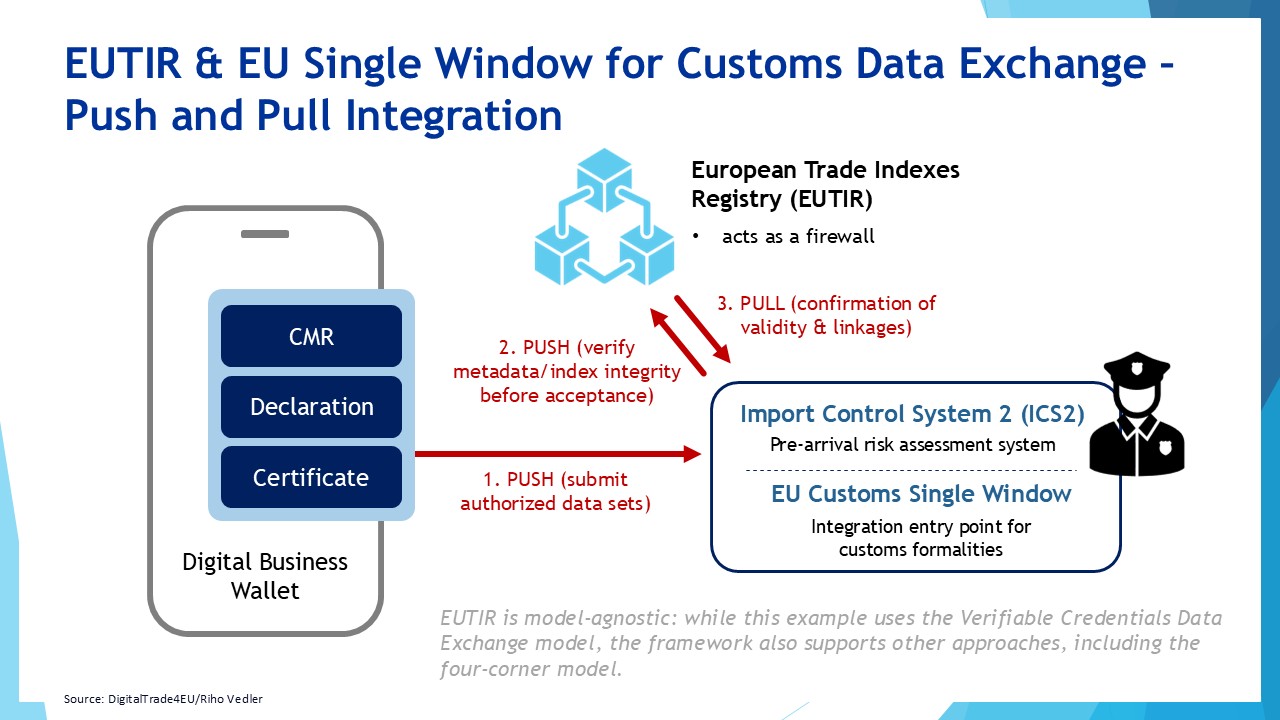
Figure 4. Illustrative Example – EUTIR & EU Single Window for Customs Data Exchange. This diagram illustrates how EUTIR functions as a trust firewall between economic operators and the EU Customs Single Window. Customs data such as CMR, declarations, and certificates are submitted through a digital business wallet. EUTIR verifies metadata integrity before acceptance, while authorities (ICS2, EU Customs Single Window) confirm validity and linkages. The push–pull mechanism reduces duplication, ensures trusted data exchange, and accelerates customs risk assessment and clearance.
Interoperability as a legislative principle
Interoperability must be treated as an active process, with outcomes embedded directly into legislation. EUTIR provides precisely this missing link – turning fragmented initiatives into a coherent, enforceable framework. Concretely, this ensures that whatever standards, platforms, or data-exchange models are used, once the metadata of an electronic document is registered and verified in the EUTIR environment, that document automatically obtains full legal effect.
This principle is not confined to digital trade. By legislating the EUTIR approach, the European Union establishes a horizontal trust layer that applies across all policy areas. Sectoral legislation can then focus on domain-specific content and technical requirements — whether in customs, finance, sustainability reporting, energy permits, or health certificates — while the legalization of documents follows one uniform and standardised process. This dual structure simplifies legislative updates, ensures consistency, and provides the Union with a one-stop trust infrastructure for the Single Market.
Coalition and Financing Needs
The concept of a European Trade Indexes Registry (EUTIR) is already backed by a broad coalition. A 108-member consortium, bringing together industry, academia, and public sector organisations, has expressed readiness to support its implementation. While technical pilots and operational activities would depend on dedicated funding, this collective endorsement demonstrates that the initiative would not be starting from scratch but could rely on an established base of expertise and commitment.
The key challenge ahead lies in ensuring stable and predictable financing. Rather than relying on fragmented or short-term project funding, the EU should anchor EUTIR in a secure funding framework. This is essential not only for long-term investment confidence but also because the initiative directly intersects with multiple EU regulations, requiring continuity and coherence across policy domains. In addition to stable financing, strong political support is indispensable, as without it the necessary legislative changes cannot be achieved.
The bigger picture
EUTIR is more than a technical system – it is a strategic enabler. It supports Europe’s digital sovereignty, strengthens cybersecurity by design (via eIDAS 2.0 trust services, NIS2 compliance, immutability of records), and positions the EU as a global benchmark for trusted digital trade infrastructures.
For businesses, it promises lower costs and greater certainty; for policymakers, a future-proof governance model; and for Europe as a whole, an opportunity to set global standards in an era where digital trust is the backbone of competitiveness and sustainability.
👉 [Full document “Towards a Trusted Digital Trade Framework: The Role of the European Trade Indexes Registry (EUTIR)” available here]
We invite policymakers, businesses, and stakeholders to join the dialogue. The EUTIR concept is not only a regulatory vision but a practical tool that can transform how Europe trades, innovates, and sustains its competitiveness globally.
Summary by DigitalTrade4.EU