

Imagine a clinician treating an unusual patient. An AI decision-support system recommends the established treatment. The clinician can see grounds for investigating another option, but doing so requires time, documentation and an explanation if anything goes wrong. Following the institutional default is faster and easier to defend. With patients waiting and professional stakes rising, the default wins. Nothing dramatic happens. One opportunity to generate evidence about an alternative simply disappears.
Multiply that decision across thousands of professionals and many years. AI adoption can improve care, reduce errors and generate new hypotheses. It can also change which actions are taken, which comparisons are made and what future systems are able to learn. A system that becomes exceptionally good at implementing established decisions may still lack the evidence needed to discover when those decisions should change.
The real test of AI-era progress is not how often people follow a recommendation. It is whether we can still produce the independent evidence needed to overturn it.
This article develops a 2026–2056 research hypothesis about that difference. Healthcare provides the clearest illustration because clinical decisions have high stakes and testing alternatives requires rigorous safeguards. The underlying concern extends to other sectors, although validation costs and methods differ. The argument is not a forecast: it is a specific mechanism with measurable implications.
1. The defensible default: why rational people stop challenging the standard
Professionals do not have to believe that AI is infallible to follow it. Once an AI recommendation becomes the institutionally endorsed standard, disagreement often requires more effort than compliance. A potential lawsuit, a threat to professional standing or a financial loss can make the safest personal choice the recognised default—even when uncertainty remains. Under rising workloads, a decision that takes minutes to accept may take hours to question.
Our model adopts a precise behavioural premise: when challenging an endorsed AI recommendation carries disproportionate personal costs, decision-makers tend to favour the easier-to-defend choice. This is an assumption for analysis, not a claim about every person or institution. Some high-responsibility environments demand stronger independent review. The point is to examine what happens when organisational incentives reward conformity more consistently than justified inquiry.[1–3]
The distinction has consequences. Standardisation is often desirable: it can remove harmful variation and make reliable practice widely available. But conformity and correctness are not synonyms. A process that records overwhelming agreement with AI cannot, on that evidence alone, establish that meaningful alternatives have been examined.
A historical analogue: credit ratings before the 2008 crisis
The problem has a recognisable historical analogue. Before the 2008 financial crisis, high credit ratings became a powerful shortcut for evaluating mortgage-related securities. Some investment and regulatory rules embedded ratings as formal decision criteria, while the US Financial Crisis Inquiry Commission later documented weaknesses in ratings and investors’ due diligence.[12] An apparently authoritative assessment had become easier to rely on than to question. The Commission recounts how Arnold Cattani of California’s Mission Bank challenged the explanation for the risk within a mortgage-backed security and ordered a sale when his questions could not be answered.[12] Credit ratings were not AI and this episode does not prove anything about long-term AI learning. It shows a simpler point: a widely accepted analytical judgement can suppress the practical incentive to examine its assumptions—and independent inquiry can expose that weakness.
2. An AI recommendation is not a scientific discovery
AI is an analytical instrument. It can connect data, established findings and human-defined goals into candidate explanations or solutions. It does not settle what humans ought to value: survival, quality of life, affordability and fairness can call for different priorities. Even an apparently novel, persuasive chain of reasoning is a hypothesis until evidence supports it.
Three outputs must therefore be counted separately: accepted AI recommendations; candidate relationships worth investigating; and new relationships independently established as valuable for a defined purpose. A recommendation can be useful without adding knowledge. A new hypothesis can fail after testing and still contribute evidence by eliminating an attractive but ineffective option. Counting model outputs as discoveries obscures this difference.
AI output ≠ validated discovery.
Validation volume ≠ validation independence.
Independence is about the source of evidence, not the number of approving systems. Two models trained on overlapping sources can repeat the same error while apparently corroborating one another. Separate evaluators, different datasets, alternative methods and new observations provide increasing opportunities to falsify a claim. What counts as sufficient independence depends on the consequence of being wrong.
What the evidence shows
In a 2026 randomised NEJM AI study, 44 physicians trained in AI literacy assessed fictional clinical cases using ChatGPT-4o. Participants exposed to flawed AI diagnostic suggestions achieved lower mean diagnostic-reasoning scores than participants receiving error-free advice: 73.3% versus 84.9%.[13] This documents a short-term behavioural vulnerability to misleading AI assistance. It does not establish that clinical discovery has declined over time.
The next link comes from machine-learning research. Adam and colleagues modelled how decisions influenced by deployed systems can alter later data and amplify errors during model updates, including in simulations informed by intensive-care data.[14, 15] Their findings establish the technical possibility of damaging feedback under specified assumptions. The complete sequence—defensible defaults, declining independent comparison and slower validated discovery—has not yet been demonstrated across decades in real health systems.
3. The hidden cost of the evidence we never collect
Suppose treatment A is well supported and appropriate for most patients, so an AI system recommends it frequently. A later biological finding suggests treatment B might work better for a specific subgroup. If the recommendation for A is rarely questioned, everyday treatment records will contain many outcomes for A and relatively few comparable outcomes for B. Good results under A cannot show what the same patients would have experienced under B. That is the missing counterfactual, and it requires sound comparison.[5]
Routine clinical data are not the whole scientific evidence base. Independent trials, registries and laboratory research can still investigate B, and no patient should be exposed to unjustified experimentation. The structural risk emerges when these alternative evidence channels are too weak to resolve important uncertainty while routine AI-influenced records dominate model development. Research on performative prediction explains why this matters: predictions can influence decisions, which in turn change the data available for future predictions.[4] An LLM does not usually rewrite its parameters whenever someone accepts an answer. The feedback loop develops when decisions shaped by earlier models are reused as training, evaluation or retrieval evidence without accounting for how those decisions were selected.
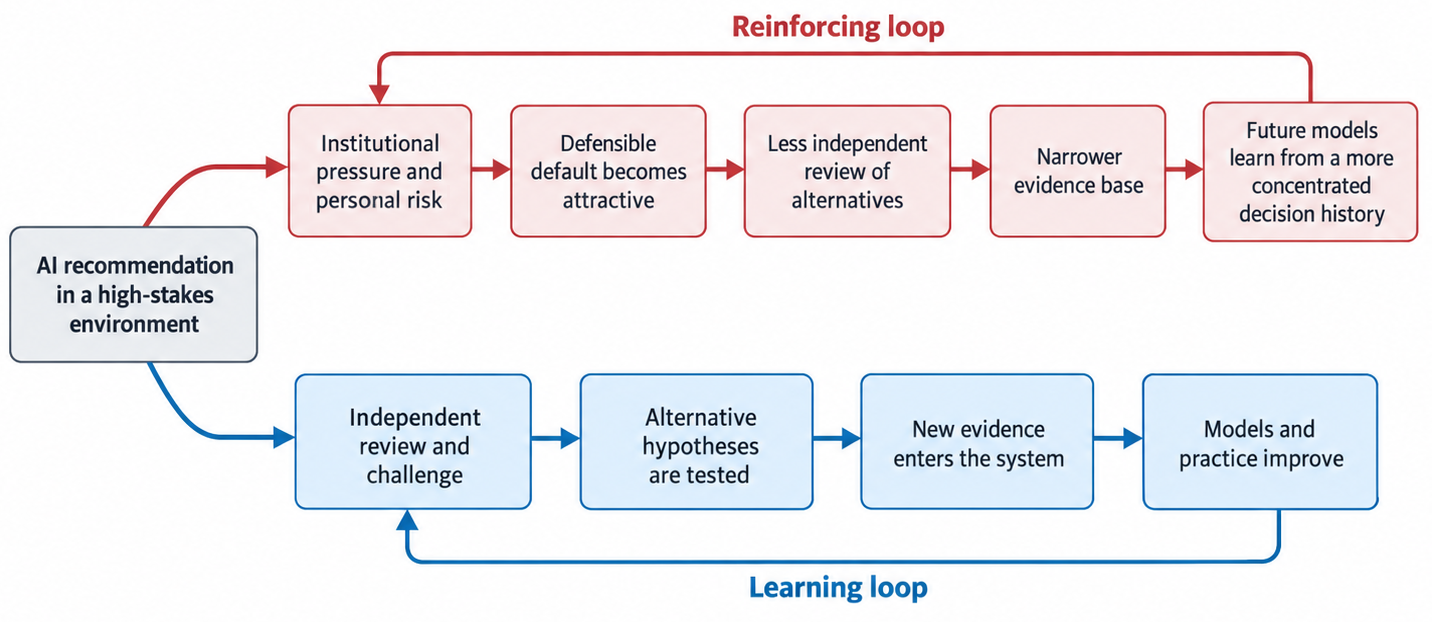
4. Two futures: reinforcement or discovery
In the reinforcing pathway, rising demand and personal exposure make the endorsed recommendation easier to accept than to challenge. Fewer important alternatives are investigated. Routine records increasingly reflect existing practice, and later models trained on those records become highly effective at reproducing it. That improvement can coexist with a growing blind spot: the system has less evidence about what works better when circumstances change.
The competing pathway starts with AI itself. A capable system can detect outliers, identify subgroups with disappointing results, expose knowledge gaps and formulate testable alternatives. It can accelerate literature review, trial design, simulation and laboratory work. A 2026 Nature study of an LLM-based co-scientist describes biomedical hypotheses taken forward to experimental testing.[7] AI can therefore expand exploration rather than merely enforce the default. A separate creative-writing experiment found stronger individual outputs but reduced collective diversity among AI-assisted work, reminding us that individual performance and diversity need separate measurement.[6]
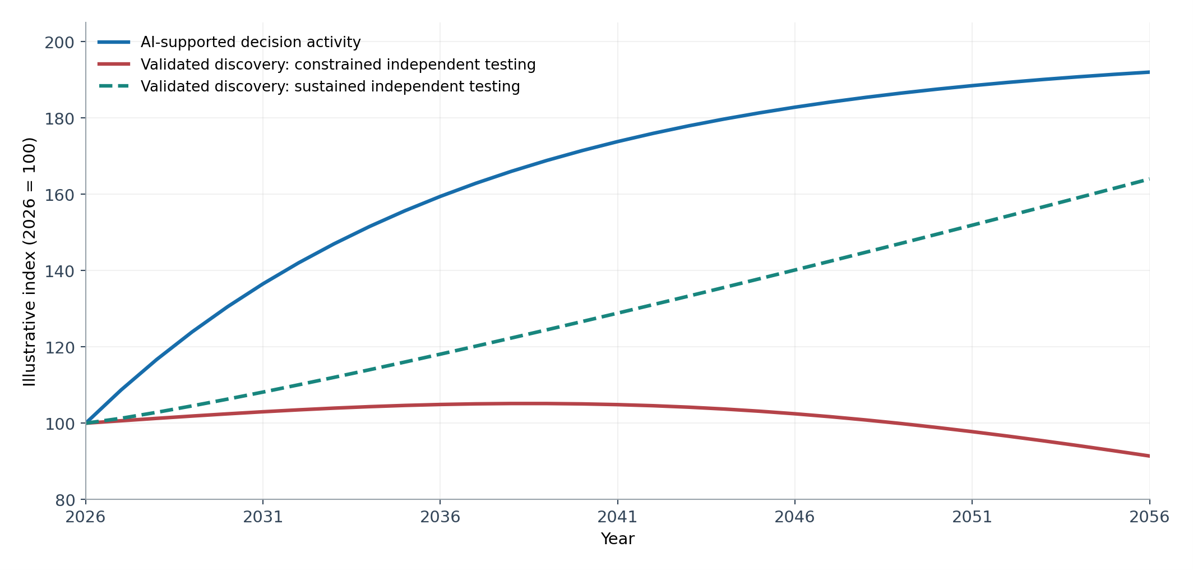
The decisive factor is not simply the number of human reviewers or automated checks. It is whether the evidence system can challenge the prevailing answer. Thousands of AI-to-AI confirmations based on shared assumptions may reveal less than one well-designed independent comparison. Equally, automated laboratories and robust research networks can generate better evidence with fewer clinician-hours. The 30-year trajectory depends on which capacity institutions choose to build. Figure 2 visualises the distinction rather than forecasting an outcome. All three curves use an identical starting index of 100 in 2026. AI-supported decision activity grows in both hypothetical settings; independently validated discovery follows different paths depending on whether suitable independent testing remains available. The values and slopes are illustrative choices, not measurements or estimated effects.
5. Five signals that an institution is losing its capacity to challenge AI
Organisations can detect this problem before any long-run effect becomes visible. Five candidate indicators can be monitored using decision logs, quality records, outcome measurements and research registers. They are most informative for uncertain or atypical cases, where simply following the standard cannot settle the question.
| Warning sign | Illustrative measure | Interpretation guardrail |
| Default convergence | Share of eligible AI-exposed decisions following the endorsed default within pre-specified uncertain or atypical subgroups; compare with ordinary cases. | Agreement can be appropriate. Compare case mix, recommendation quality and alternatives before interpreting a rise. |
| Review coverage | Documented substantive independent reviews ÷ all cases meeting pre-defined review criteria (not just escalations). | Measure against all qualifying cases, not only escalated ones. |
| Confidence–outcome gap | Difference between predicted and observed outcomes by subgroup, model version and time period, using calibrated scores where available. | Use validated model scores; free-form LLM wording is not calibrated probability. |
| Unresolved evidence backlog | Count, age and priority of unresolved questions without a credible evaluation route, linked to a question register. | A larger register can initially signal improved detection. |
| Research conversion | Researchable questions per 100 qualifying uncertainty events; proportion approved and independently evaluated. | Reward useful questions and sound tests, not sheer quantity. |
No single indicator is a verdict. A high agreement rate may indicate an excellent recommendation; a surge in research questions may simply mean more noise. Look instead for combinations: more default-following, fewer substantive comparisons and growing unanswered questions despite changing outcomes or populations.
How to distinguish an efficient default from a harmful one
Start with a clear comparison group: define the decision type, the genuinely uncertain subgroup and all cases eligible for independent review. Establish a local baseline, ideally using existing records, and record case mix, staffing, model version and data completeness. Then have reviewers assess a sample of decisions without seeing the AI recommendation where feasible. Compare their findings with patient or operational outcomes. These checks help determine whether increased agreement reflects better practice or simply weaker scrutiny.[19]
For instance, among comparable uncertain cases, default-following might rise from 70% to 90% while substantive reviews fall from 30% to 10%. That pattern deserves investigation, not automatic condemnation. The important follow-up is whether alternatives remain available for evaluation, whether outcomes differ by subgroup and whether the institution has credible evidence for maintaining its default. Thresholds should be tied to local baseline variation and the stakes of an error, not imported as universal rules.
A workable empirical programme has four layers. Retrospective records can describe whether alternatives become less represented. Prospective logs can record which model suggested what, whether a professional agreed or deviated, why, and what happened afterwards. Controlled vignette or simulation studies can isolate how institutional endorsement changes behaviour. Longitudinal studies can then test how these altered choices affect later data and model performance. Each layer answers a distinct question; none should be mistaken for evidence it cannot provide.
Identifying causal effects requires careful research design. Controlled rollouts, interrupted time-series and suitable causal-domain-shift methods can help where their assumptions hold.[16] OPAB has been proposed as an intervention-testing approach, but the cited 2026 work is a preprint rather than a clinically established method.[17] In medicine, research must preserve patient safety and appropriate ethical and legal oversight. The point is to build better tests, not to encourage unregulated deviations from proven treatment.
Reliable evidence also needs an audit trail. HL7 FHIR Provenance and AuditEvent can support the recording of data origins and relevant system events.[18] An organisation must still design records that distinguish the AI recommendation from the final human choice, preserve model and data versions, and capture whether an independent comparison was made. Without those distinctions, a later model inherits outcomes but not the conditions that produced them.
6. Who pays for evidence that can overturn the default?
A research gap does not close merely because an organisation records it. Time, expertise, suitable data and funding are required to investigate alternatives. In a busy hospital, allocating all of this work to clinicians already treating patients ensures that independent inquiry competes with immediate care. Protecting the capacity to learn therefore requires an explicit budget and a responsible institution.
Costs can be divided by purpose. Developers and deployers should plan for appropriate monitoring and performance assurance in their operational and procurement arrangements.[8] Research questions whose benefits extend across providers need broader mechanisms: pooled clinical networks, public-interest research grants, multicentre comparisons and transparent access to eligible evidence. Contracts can specify who maintains the question register, how high-priority uncertainties are selected and how negative results are shared.
This is not a call to test every recommendation or impose an arbitrary percentage levy. The sharper proposal is to protect resources for questions that matter most: unusual cases, deteriorating subgroup outcomes, uncertain evidence and decisions whose consequences are difficult to reverse. If no one owns or funds those questions, they will remain unanswered however sophisticated the AI becomes.
7. Europe should measure learning, not only adoption
European digital governance rightly prioritises trustworthy systems, sound data use and effective oversight. But a deployment programme is incomplete if success is measured mainly by usage, speed or agreement with the model. The EU AI Act addresses important requirements for certain high-risk systems, including risk management and human oversight, and includes regulatory sandboxes.[9] Those provisions do not replace a functioning scientific evidence system. A system can be compliant and still leave its most important unresolved questions untested.
The point also matters to the context in which DigitalTrade4.EU participates in European consultations. The EHDS Article 70 initiative focuses on standardised templates for secondary-use data access; the separate AI Act Articles 75c and 75d initiative concerns procedural aspects of AI Office enforcement.[10, 11] Neither is a general mandate to regulate thirty years of discovery. Still, both sit within a wider European question: do governance structures preserve enough traceability and independent evidence to revise accepted decisions when the facts change?
This analysis offers a research-based lens for that question, not a substitute for legal proposals within the narrow scope of an implementing act. The wider standard for success should include the continuing ability to challenge established decisions with new evidence.
8. Conclusion: a defensible decision is not the end of inquiry
AI can improve present-day decisions and dramatically expand the search for new relationships. That promise is real. So is the institutional temptation to treat a widely endorsed recommendation as the end of the discussion. When the cost of challenging the default falls on one person but the value of discovery is shared across many, the evidence needed to overturn a standard is easily underproduced.
The response is not less AI and not indiscriminate experimentation. It is a stronger connection between AI deployment and independent discovery: explicit human goals, review of uncertain cases, meaningful alternative testing, traceable decisions and research capacity that survives routine service pressures. We should measure not only how often AI is used and how many decisions it supports, but how often important uncertainty becomes evidence capable of changing practice.
A system that cannot challenge its most defensible answers is not a learning system.
Author: Riho Vedler
Independent Researcher / Policy Analyst, DigitalTrade4.EU
References and legal context
- March, J. G. (1991). Exploration and Exploitation in Organizational Learning. Organization Science, 2(1), 71–87. Source
- Edmondson, A. (1999). Psychological Safety and Learning Behavior in Work Teams. Administrative Science Quarterly, 44(2), 350–383. Source
- Goddard, K., Roudsari, A., & Wyatt, J. C. (2012). Automation Bias: A Systematic Review. Journal of the American Medical Informatics Association, 19(1), 121–127. Source
- Perdomo, J., Zrnic, T., Mendler-Dünner, C., & Hardt, M. (2020). Performative Prediction. ICML, PMLR 119. Source
- Hernán, M. A., & Robins, J. M. (2020). Causal Inference: What If. Chapman & Hall/CRC. Source
- Doshi, A. R., & Hauser, O. P. (2024). Generative AI Enhances Individual Creativity but Reduces the Collective Diversity of Novel Content. Science Advances, 10(28), eadn5290. Source
- Gottweis, J., Weng, W.-H., Daryin, A., et al. (2026). Accelerating Scientific Discovery with Co-Scientist. Nature, 655, 487–496. Source
- WHO (2023). Regulatory Considerations on Artificial Intelligence for Health. Source
- European Union. Regulation (EU) 2024/1689 (AI Act), as amended: Articles 9, 14 and 57. Source
- European Union. Regulation (EU) 2025/327 (EHDS), Article 70; European Commission initiative 16712, templates for secondary use. Source
- European Union. AI Act, Articles 75c and 75d, as amended; European Commission initiative 19292, related implementing act. Source
- US Financial Crisis Inquiry Commission (2011). The Financial Crisis Inquiry Report, pp. 120 and 126. Source
- Qazi, I. A., Ali, A., Khawaja, A. U., et al. (2026). Automation Bias in Large Language Model–Assisted Diagnostic Reasoning among Physicians Trained in AI Literacy—A Randomized Clinical Trial. NEJM AI, 3(5). DOI: 10.1056/AIoa2501001. Source
- Adam, G. A., Chang, C.-H. K., Haibe-Kains, B., & Goldenberg, A. (2020). Hidden Risks of Machine Learning Applied to Healthcare: Unintended Feedback Loops Between Models and Future Data Causing Model Degradation. Proceedings of Machine Learning for Healthcare, PMLR 126, 710–731. Source
- Adam, G. A., Chang, C.-H. K., Haibe-Kains, B., & Goldenberg, A. (2022). Error Amplification When Updating Deployed Machine Learning Models. Proceedings of Machine Learning for Healthcare, PMLR 182, 715–740. Source
- Boeken, P., Zoeter, O., & Mooij, J. M. (2024). Evaluating and Correcting Performative Effects of Decision Support Systems via Causal Domain Shift. Proceedings of Causal Learning and Reasoning, PMLR 236, 551–569. Source
- Gower-Winter, B., & Krempl, G. (2026). Actions Have Consequences: Detecting Outcome Performativity Using Intervention Testing. arXiv preprint, 2607.26908; not presented here as a clinically validated method. Source
- HL7 International. FHIR Release 5: Provenance and AuditEvent resource definitions. Technical standard describing resource provenance and audit events, not a turnkey clinical AI causal-research registry. Source [19] Scott, P. J., Brown, A. W., Adedeji, T., Wyatt, J. C., Georgiou, A., Eisenstein, E. L., & Friedman, C. P. (2019). A Review of Measurement Practice in Studies of Clinical Decision Support Systems 1998–2017. Journal of the American Medical Informatics Association, 26(10), 1120–1128. DOI: 10.1093/jamia/ocz035.